Retail Exhibit Design for WD‑40
Retail Exhibit Design for WD‑40
Design Sprint
Design Sprint
A one‑week corporate design sprint run with WD‑40 and Thomas Jefferson University. The brief was to create an in‑store exhibit for the WD‑40 Specialist line; a range most customers walk past without understanding how it differs from the standard formula. The challenge: make the right product obvious, make the differences tangible, and do it within a display that could be manufactured, shipped, and deployed easily. My role: ideation, 3D modeling, rendering, 3D‑printed prototyping and model making.
A one‑week corporate design sprint run with WD‑40 and Thomas Jefferson University. The brief was to create an in‑store exhibit for the WD‑40 Specialist line; a range most customers walk past without understanding how it differs from the standard formula. The challenge: make the right product obvious, make the differences tangible, and do it within a display that could be manufactured, shipped, and deployed easily. My role: ideation, 3D modeling, rendering, 3D‑printed prototyping and model making.
Title
Title
Retail Exhibit Design for WD‑40
Retail Exhibit Design for WD‑40
Industry
Industry
Automotive Accessories
Automotive Accessories
Date
Date
2024
2024
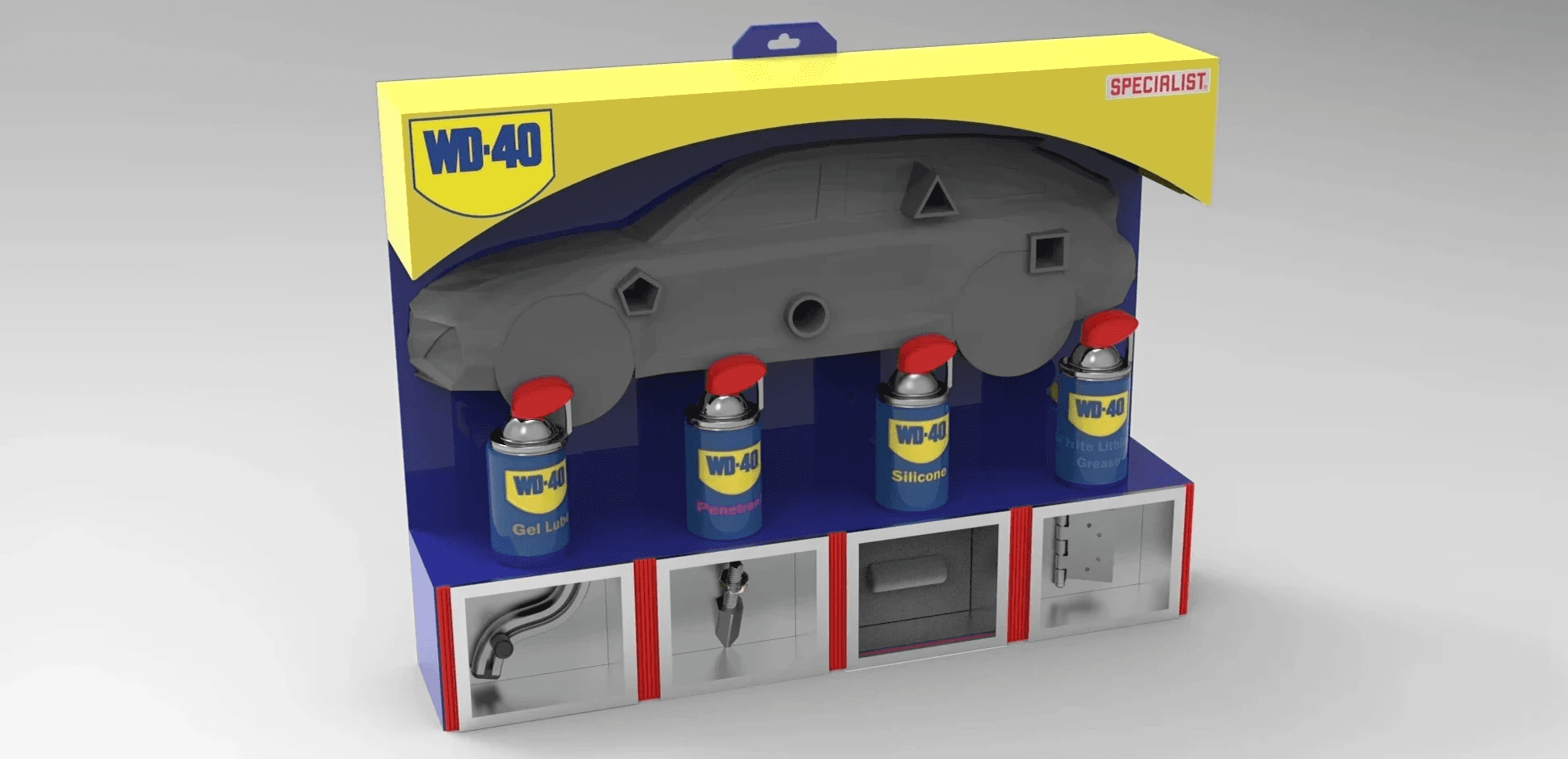
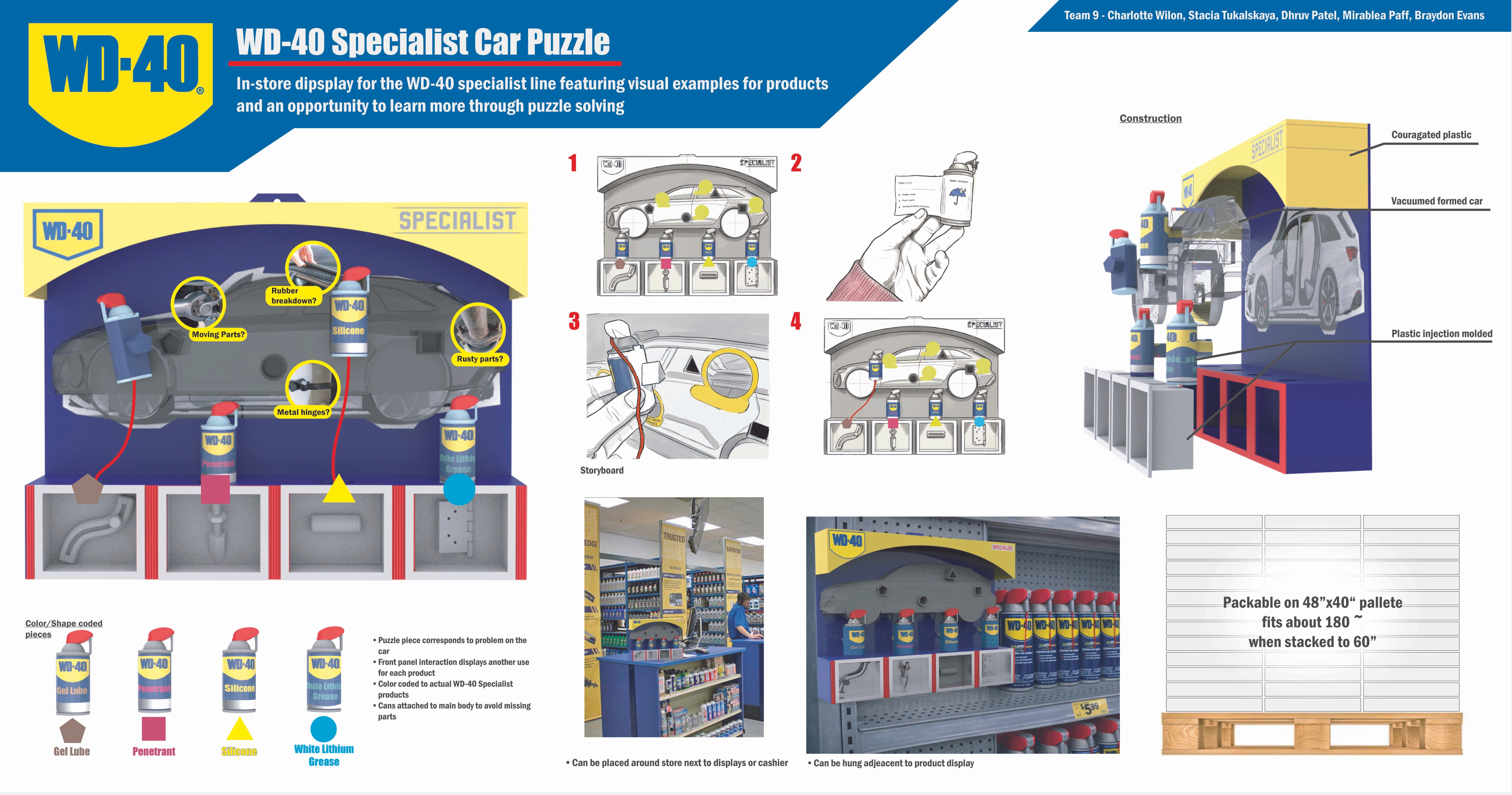
A cross-section of a car with four problem areas called out directly on the body, each mapped to its corresponding Specialist product through a colour and shape-coded puzzle piece system, so matching the right product to the right problem becomes a physical action rather than a label-reading exercise. The actual cans attach to the display body, a front panel adds secondary use cases for each product, and the whole thing packs flat onto a standard 48" x 40" pallet for straightforward retail distribution.

Research phase
Research phase
The first day was dedicated to research. We mapped the full Specialist range : penetrant, gel lube, white lithium, silicone, contact cleaner, dry lube; and clarified what each product actually does. Inspiration came from outside the category: museum exhibits, tactile toys, and interactive retail environments that create engagement through physical interaction rather than text. The core question: how do we make customers feel he difference between products instead of just reading about it?
The first day was dedicated to research. We mapped the full Specialist range : penetrant, gel lube, white lithium, silicone, contact cleaner, dry lube; and clarified what each product actually does. Inspiration came from outside the category: museum exhibits, tactile toys, and interactive retail environments that create engagement through physical interaction rather than text. The core question: how do we make customers feel he difference between products instead of just reading about it?
Approach
Approach
Three directions emerged:
A split‑section car model mapping vehicle parts to their matching Specialist product.
A “tinker box” that lets customers compare Specialist vs. standard formulas side‑by‑side.
A lower‑cost story panel for shelves or endcaps. I led ideation sketching and early CAD, exploring how each concept could communicate product differences through touch, movement, and simple cues.
Three directions emerged:
A split‑section car model mapping vehicle parts to their matching Specialist product.
A “tinker box” that lets customers compare Specialist vs. standard formulas side‑by‑side.
A lower‑cost story panel for shelves or endcaps. I led ideation sketching and early CAD, exploring how each concept could communicate product differences through touch, movement, and simple cues.


Mid Crit
Mid Crit
Three directions were reviewed. Feedback pushed us to merge the strongest elements; the car puzzle’s clarity and the tinker box’s tactile comparison, into one display. We replaced printed material samples with real ones (rusted bolts, rubber, metal surfaces) to show actual product effects. Pallet constraints (48" × 40") shaped the footprint. I refined the CAD, printed test pieces, and built the updated model for the next round.
Three directions were reviewed. Feedback pushed us to merge the strongest elements; the car puzzle’s clarity and the tinker box’s tactile comparison, into one display. We replaced printed material samples with real ones (rusted bolts, rubber, metal surfaces) to show actual product effects. Pallet constraints (48" × 40") shaped the footprint. I refined the CAD, printed test pieces, and built the updated model for the next round.

A distributed work day. The team split deliverables; one member designed and printed miniature WD-40 keychain models to hand out at final crit, another compiled the full asset list for the final poster: hero shots, in-store renders, storyboard, manufacturability specs, and graphics. The model refinement continued in parallel, working toward a single resolved direction from the three we'd started with.
A distributed work day. The team split deliverables; one member designed and printed miniature WD-40 keychain models to hand out at final crit, another compiled the full asset list for the final poster: hero shots, in-store renders, storyboard, manufacturability specs, and graphics. The model refinement continued in parallel, working toward a single resolved direction from the three we'd started with.

The final exhibit is an interactive in‑store display built around a cross‑section of a car interior. Four problem areas - moving parts, rubber breakdown, metal hinges, rusty fasteners; are mapped to their corresponding Specialist product using a color‑ and shape‑coded puzzle system. Gel Lube, Penetrant, Silicone, and White Lithium Grease each get a distinct color and geometric marker, turning product selection into a physical matching action. I modeled and rendered the full display and printed the puzzle pieces for testing.
The final exhibit is an interactive in‑store display built around a cross‑section of a car interior. Four problem areas - moving parts, rubber breakdown, metal hinges, rusty fasteners; are mapped to their corresponding Specialist product using a color‑ and shape‑coded puzzle system. Gel Lube, Penetrant, Silicone, and White Lithium Grease each get a distinct color and geometric marker, turning product selection into a physical matching action. I modeled and rendered the full display and printed the puzzle pieces for testing.
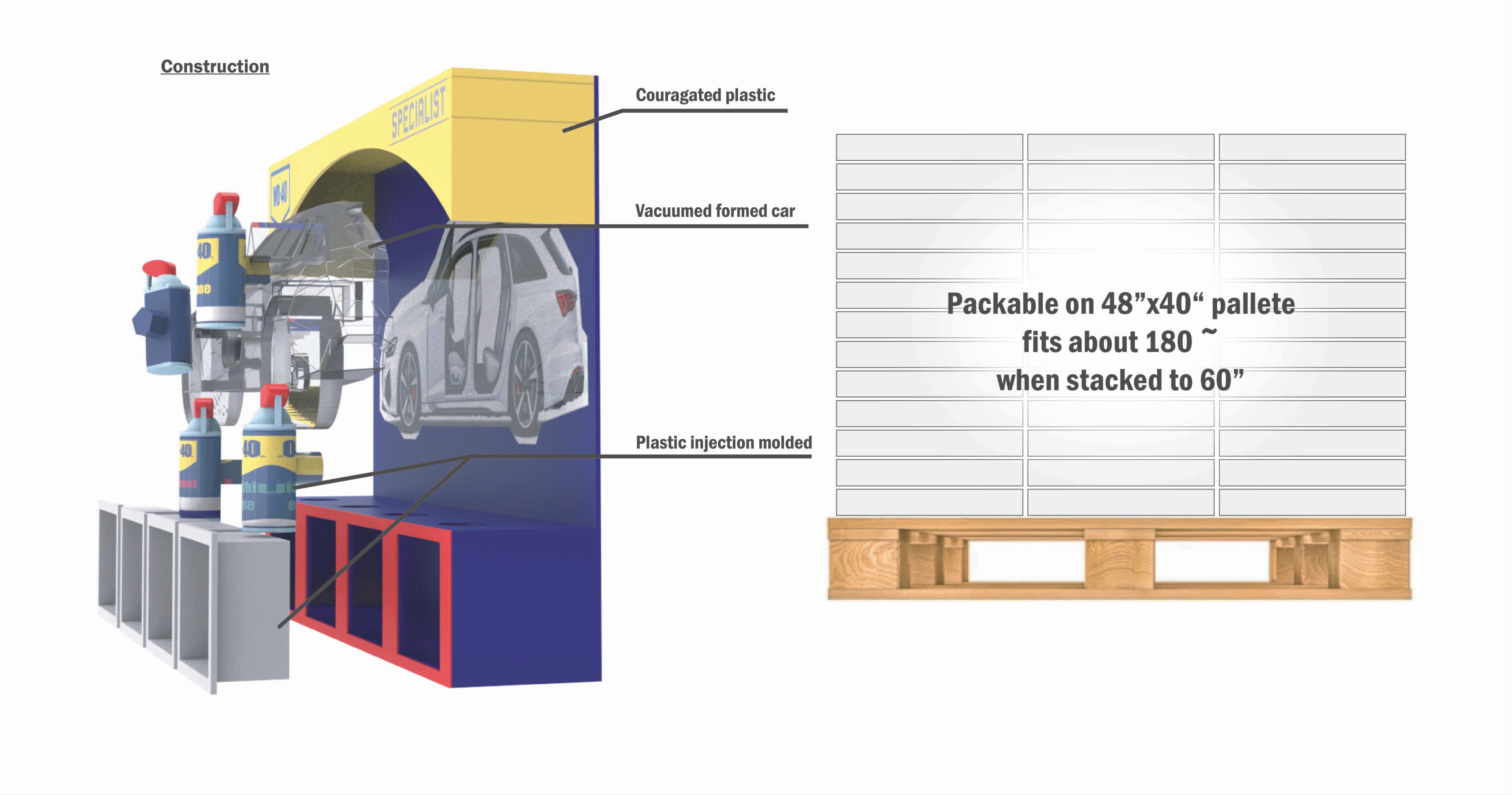
The canopy uses corrugated plastic, the car cross‑section is vacuum‑formed, and the interactive components are injection‑molded for durability. The entire display packs flat onto a standard 48" × 40" pallet, fitting roughly 180 units stacked to 60" for efficient nationwide distribution. It can be deployed freestanding near checkout or hung beside the WD‑40 shelf, giving retailers flexibility without requiring dedicated floor space.
The canopy uses corrugated plastic, the car cross‑section is vacuum‑formed, and the interactive components are injection‑molded for durability. The entire display packs flat onto a standard 48" × 40" pallet, fitting roughly 180 units stacked to 60" for efficient nationwide distribution. It can be deployed freestanding near checkout or hung beside the WD‑40 shelf, giving retailers flexibility without requiring dedicated floor space.
Projects
Explore more like this one




Explore the other projects in this collection — each detail page now surfaces work beyond the current case study.